
Who Wrote Your Story?
Power doesn't disappear. It evolves.

Might is right.
Before you close the tab, keep it open. Not as a moral argument. As a description. The operating system beneath every society ever built. Resources are finite. Competition is inevitable. Competition produces winners who set terms. Force advantage converts into resource control, resource control into rule-making, rule-making into the laws and institutions that govern your daily life.
This isn’t cynicism. It’s first principles. And once you see it clearly, something else becomes visible immediately:
Pure domination is locally optimal but systemically stupid.
The moment you introduce a second person, the math changes. Destroy them, and you lose what they produce. Dominate them completely,y and their output diminishes while your load increases. Cooperation and combined output exceed what either produces alone. Even in the most competitive dynamics, the higher-might strategy turns out to be a coalition. The alpha who hoards power stagnates. The one who develops capability around him compounds it.
So if might is the foundation, what do you build on top of it?
Every civilization that survived long enough to matter has answered that question the same way. You build a story.
The Greeks encoded what a man should be into Homer. The Japanese built it into Musashi. The Persians spent thirty years writing the Shahnameh to preserve their identity after the conquest had nearly erased it. The Bhagavad Gita delivered its philosophy mid-battle to a man who didn’t want to fight. Different wrappers. Identical function.
Here is how to be a good member of this particular human project.
These weren’t entertainment. They were operating systems layered on top of the first one; wisdom in a form that the culture could carry, portable, repeatable, transferable across generations.
Humanity’s best attempt at building something durable on a foundation of might.
And it works. Until it doesn’t.
Because every story passes through hands, and every set of hands adds something of authority, interpretation, and institutional weight. The chain runs in the same direction every time:
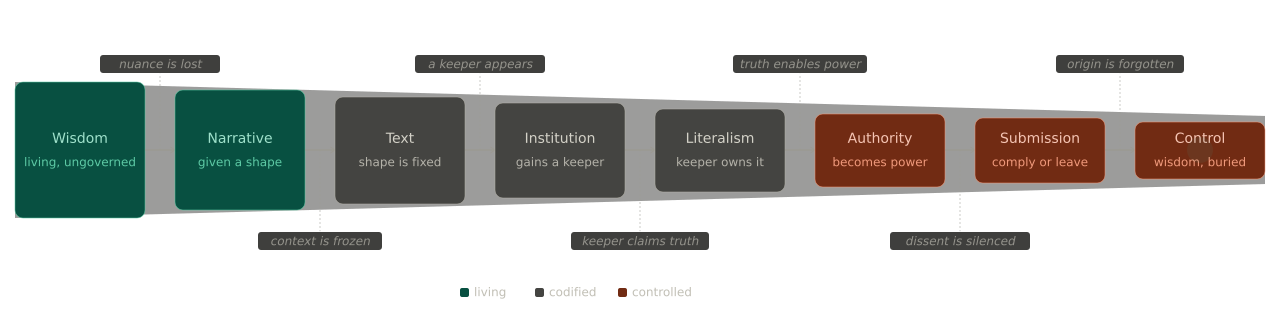
By the time the wisdom reaches you, it has passed through so many hands that what arrives isn’t the original insight. It’s the institutional version. Flattened. Owned. Enforced not by force anymore, but by Language; and sometimes force to…
In my MFT studies. One of the first things you encounter in that training is a framework that sounds academic until you realize it’s describing your actual life.
Modernism holds that objective truth exists, can be found through the right method, and, once found, should be applied universally. The expert arrives with answers. There is a correct family structure; a right way to be a man or a woman.
Postmodernism says stop. Ask who named it truth and why. There is no view from nowhere, only views from somewhere, shaped by whoever held power long enough to make their perspective look like common sense.
Social constructionism is the mechanism beneath that. Language doesn’t neutrally reflect reality; it builds it. The words used to categorize your experience actively shape what you see and what becomes possible. The naming does the work.
Put simply: the cage is made of vocabulary. And you don’t need guards when people police themselves.
This is might in its most evolved form. Not force. Not law. The story you carry inside your head that you’ve never once questioned because it arrived before you knew there were other options.
Here is what nobody in this conversation wants to admit.
Both the feminist narrative and the patriarchal narrative are running the codification trap. They just started from different corners of the mat.
Feminism began as legitimate re-authoring. Women identifying the dominant discourse, naming the invisible cage, reclaiming definitional power. That’s the postmodern move done correctly, wisdom emerging from lived experience.
But at some point, the re-authoring became its own institution. The wisdom codified. The narrative hardened into doctrine. I don’t need a man to stop being a liberated conclusion and become a new literalism. A different cage built from the same blueprint.
Patriarchy ran the same play in the other direction. What may have started as a functional social organization under genuine survival pressure, real division of labor, real physical asymmetry, and real stakes calcified into doctrine. Man as provider stopped being a role and became a prison for men who wanted something different.
And because both are operating in silos, they use each other’s worst expressions as evidence. The most aggressive feminist confirms every patriarchal fear. The most rigid traditionalist confirms every feminist critique. The echo chambers don’t just survive on each other; they require each other.
Neither story is complete. Both contain real wisdom buried under layers of institutional calcification. And no meaningful progress can be made until someone is willing to return to first principles rather than defend their codified position.
Those who have followed me this far know I like to relate things to Brazilian jiu-jitsu.
There is essentially no scenario in which I beat a black belt today. That is simply true. My options when I face that reality are limited:
Quit. Accept permanent subordination and walk away.
Pretend. Convince myself I can overpower what I can’t, get submitted repeatedly, and learn nothing.
Or study the system. Learn how force actually moves, where leverage lives, and how a smaller input can produce a larger output when you understand the mechanics well enough.
The third option is jiu-jitsu as epistemology. You’re not rejecting might-is-right. You’re learning it at a deeper level than the person who only knows how to be bigger.
The person who never sees the blueprints of their inherited story is the blue belt who doesn’t know he’s on the mat getting submitted constantly by language, by institutional power, by narratives authored before he was born, and experiencing it as just life. Just the way things are.
Re-authoring isn’t rejecting the mat. It’s finally understanding where the leverage is.
I spent a few weeks with a woman who was sharp, interesting, and genuinely challenging to be around. I stayed because of that. It’s rare. It broke when she told me she didn’t really need a man. What I saw in that moment, two people sitting across from each other, each living inside a story written long before they met. Hers was built around self-sufficiency as survival, independence as identity, and need as vulnerability. Mine built around provision as purpose, presence as proof of worth.
What broke wasn’t the connection. What broke was two codified positions meeting at the wall, where neither could give ground without feeling like they were surrendering the story entirely.
That’s not a personal failure. That’s a civilization problem in miniature.
And it doesn’t get solved by one silo winning. It gets solved by two people willing to go back to first principles together, asking not whose story is right but who built these stories, whether they still serve us, and what we would build if we were actually choosing.
That requires principles over tribe. Curiosity over position. The willingness to sit with a question that doesn’t flatter either side.
The wisdom was always there beneath the patriarchy and beneath the feminism and beneath every institution that calcified around a living idea.
The question isn’t which codified story wins.
The question is whether you’re willing to go back far enough to find what the story was actually trying to say and whether you can do that work alongside someone who started from a different corner of the mat.
Who wrote your story?
And more importantly, are you ready to find out?
~Tyler
No Quarter: A Modern Man’s Journal. Not the journal of a modern man.
If this landed, forward it to someone who needs it.